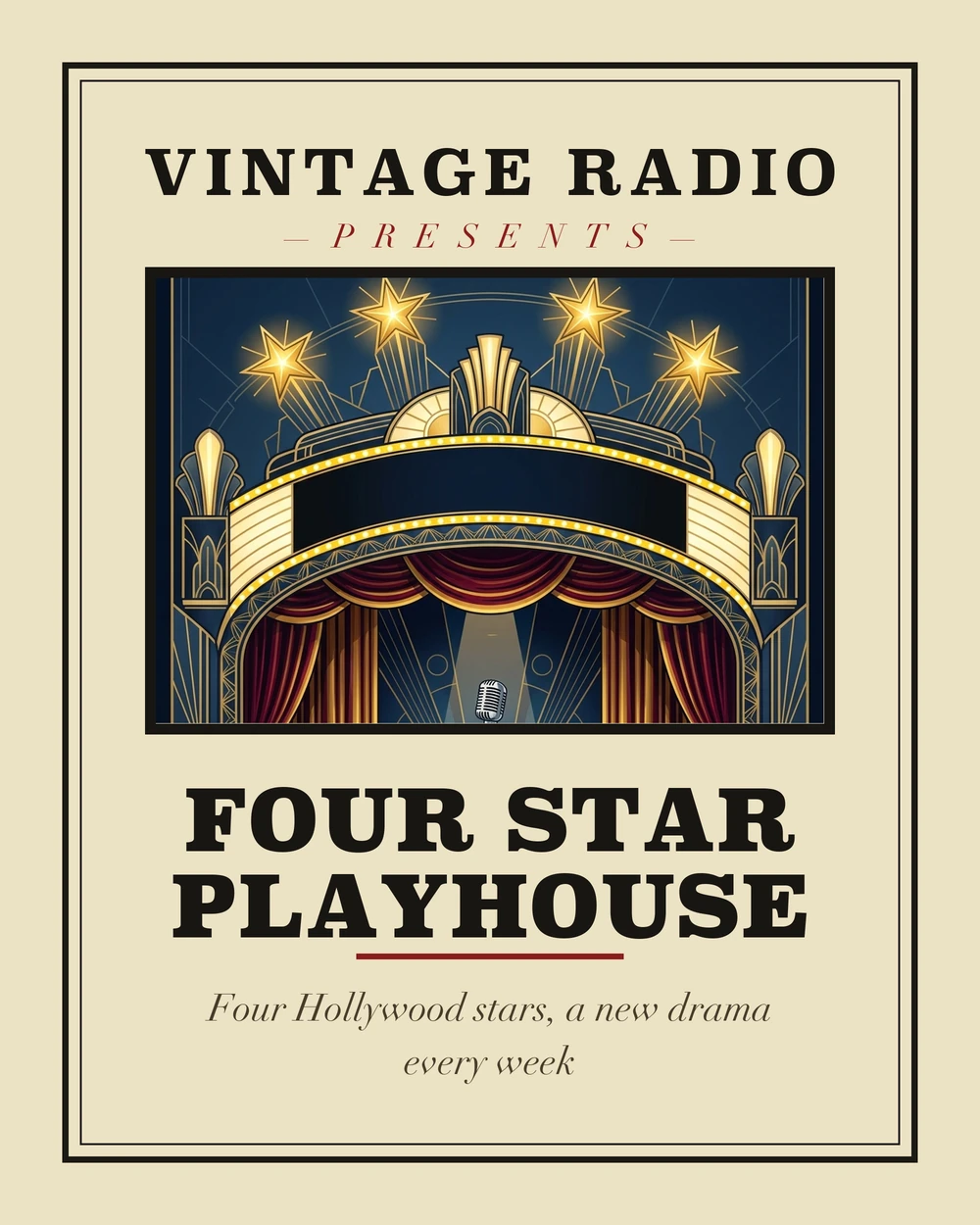
Four Star Playhouse
How It Got on the Air
Four Star Playhouse arrived on NBC Radio in the summer of 1949 as a direct response to one of the most disruptive moments in broadcast history. CBS had just pulled off an audacious raid on NBC's talent roster, luring Jack Benny, Amos 'n' Andy, and Edgar Bergen across the dial in a matter of months. NBC's answer was to flood the summer schedule with new programs built around big Hollywood names, betting that film stardom could plug the gap. Four Star Playhouse was one of at least ten new shows developed that season by NBC's West Coast programming department, and it took dead aim at the CBS Family Hour of Stars — a comparison Variety made explicitly at the time, calling Four Star Playhouse "NBC's answer to CBS' Family Hour of Stars."
The concept was straightforward: four well-known film actors — Fred MacMurray, Loretta Young, Rosalind Russell, and Robert Cummings — would rotate through the lead role, each taking one episode per month. The stories came from Cosmopolitan magazine, adapted by writer Milton Geiger, and ranged in tone from comedy to melodrama. Every play was built around a single strong central character, which made the rotating-star format work cleanly. Don Sharpe produced, Warren Lewis directed, and Albert Harris handled the music as both conductor and composer. The show aired Sundays at 8 p.m. in a 30-minute slot, sustaining — meaning unsponsored — for its entire run.
The Billboard noted in its July 2, 1949 issue that NBC intended these new summer programs to be treated not as fill-ins but as serious candidates for "long-term web tenancy." That optimism didn't survive the season. The strategy of flooding the schedule with Hollywood-star vehicles, reasonable on paper, ran into a simple problem: so many similar shows were on the air simultaneously that none of them cut through. Four Star Playhouse wrapped after thirteen episodes on September 11, 1949, never having picked up a sponsor.
The People Behind It
The supporting cast that rotated through the show's thirteen episodes included some names worth picking out. Ira Grossel, who appeared in supporting roles during the run, was the actor later known as Jeff Chandler. William Conrad, who would go on to play Marshal Matt Dillon on the radio version of Gunsmoke, turned up in supporting parts, as did Frank Lovejoy, Lurene Tuttle, Paul Frees, Lawrence Dobkin, Elliot Lewis, and Shirley Mitchell — a cross-section of working Hollywood radio talent in the late 1940s. Janet Waldo, Jeanne Bates, Joe DuVal, Willard Waterman, Jack Edwards, Mary Jane Croft, Frank Nelson, Charles Seel, Herb Butterfield, Shep Menken, Dan O'Herlihy, and Ken Christy filled out the ensemble across the run.
Two sources disagree on who announced the show — one credits Frank Barton, another Edward King — and that small uncertainty is a fair emblem of how lightly documented the series remains. It was a summer experiment, unsponsored and short-lived, and the paper trail reflects that.
What the show did produce, despite its brief life, was a core creative partnership. Don Sharpe's producer credit on the radio series would carry directly into what came next. And the format itself — rotating stars anchoring self-contained, character-driven plays drawn from a recognized magazine source — proved durable enough to get a second look almost immediately.
What Survived and What It Sounded Like
Six episodes of the radio series are known to survive: "Third Girl from the Right" from late July 1949, "The Hunted" and "The Incredible Anna Lee" from August, and "Corey," "Surprise for the Professor," and "Paradise U.S.A." closing out the run in September. Episode dates and titles are noted as approximate by the sources that catalogued them, and researchers disagree about the precise end date of the series — whether it concluded September 11, September 18, or September 25. The surviving record thins out around the edges.
The surviving episodes reflect the show's consistent approach: single-character stories with enough range in tone to keep the rotation from feeling repetitive. The Cosmopolitan source material gave the adaptations a certain polish — these were stories written for a broad popular audience and already shaped around emotional hooks before Geiger got to them. One retailer's description of the series as "well-funded and known for lively, high quality writing and acting" captures something real about the production's ambition, even if the network's strategy around it ultimately didn't pan out.
The Television Revival and What It Built
The radio series ended in September 1949, but the Four Star Playhouse name and format came back three years later in a form that lasted considerably longer. On September 25, 1952, CBS premiered a television version — and this time it ran for four seasons, 129 episodes, and became the seedbed for one of the most productive independent production companies in early television.
The television version was built around a different ownership model. Dick Powell, Charles Boyer, and David Niven co-owned the production company — Four Star Productions — drawing on the star-ownership approach Lucille Ball and Desi Arnaz had pioneered at Desilu. The original four proposed television stars were Boyer, Powell, Rosalind Russell (returning from the radio version), and Joel McCrea. Both Russell and McCrea dropped out before the debut — McCrea because of his radio commitment to Tales of the Texas Rangers — and David Niven stepped in as the third rotating lead, with Ida Lupino appearing as a performer without an ownership stake.
Don Sharpe, producer of the radio series, moved over as executive producer of the television version, maintaining continuity between the two runs. The show debuted with "My Wife Geraldine," starring Charles Boyer and written by Larry Marcus. In its first season it aired bi-weekly on CBS Thursday nights at 8:30, alternating with the television Amos 'n' Andy — a scheduling footnote with some irony given that Amos 'n' Andy was one of the shows whose defection to CBS had prompted the original radio series. The Singer Company and Parker Pens sponsored the initial bi-weekly run; Bristol-Myers came on as an alternate sponsor when the show moved to a weekly schedule in fall 1953.
The television Four Star Playhouse never cracked the Nielsen Top 30, but it earned consistent critical recognition. Billboard voted it the second-best filmed network drama series in 1954. Blake Edwards wrote and directed for the show, making his directorial debut there in 1952, and created the recurring character of Willie Dante — a gambling-house operator played by Dick Powell across roughly eight episodes — who was later spun off into the 1960 series Dante, starring Howard Duff. A February 1954 episode served as the pilot for Meet McGraw, with Frank Lovejoy in the lead; Lovejoy had also turned up the previous November in "Search in the Night," reprising his Nightbeat role as Chicago reporter Randy Stone. The 1954 Directors Guild Award for Outstanding Directorial Achievement in Television went to an episode of the series. Guest leads over the four-season run included Ronald Colman, Joan Fontaine, Merle Oberon, and Teresa Wright, alongside the three rotating leads. Writers Gwen and John Bagni contributed multiple scripts between 1952 and 1954, with a particular focus on interpersonal drama and moral dilemmas.
One distinction set the television series apart from most of its peers: it was produced in Hollywood on film rather than live in New York. At a time when prestige television drama was largely a New York enterprise, Four Star Playhouse was making high-quality filmed drama on the West Coast. When Official Films syndicated a 153-episode package under the title Star Performance in the late 1950s — bundling the series together with the anthology Stage 7 from 1954–55 — those reruns won Billboard's award for best syndicated dramatic show in 1956. The majority of the television episodes survive.
Four Star Productions outlasted the television series itself by many years. The company went on to produce Dick Powell's Zane Grey Theatre, The Rifleman, Burke's Law, The Big Valley, The Rogues, and Honey West, among others. Powell remained at the head of the operation until his death in January 1963. The summer radio experiment that NBC launched to recover from a talent raid didn't last a season, but the format and the people behind it built something that shaped a decade of American television.